Sunday, June 07, 2009

I'm getting that tingly feeling again...must be time for Comic Con rumors!

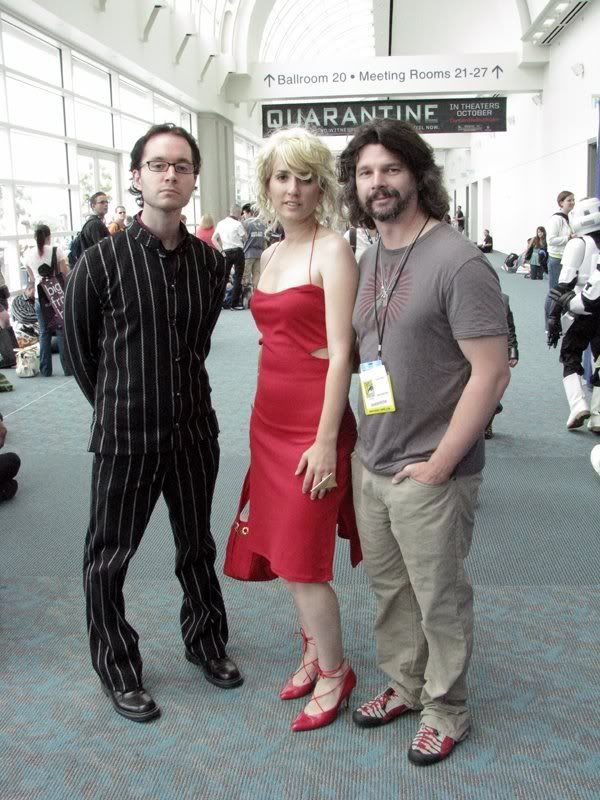
RDM playing nice in the halls of Comic Con 2008...


First bits and pieces of Comic Con 2009 panel info, both rumored and officially announced, have begun to trickle onto the blogosphere this past week for some of the TV and film projects. I'll be tracking a lot of both over on FanGrrl Magnet if you are curious.

But to the question that you dear readers most want here at Sitrep...what about BATTLESTAR GALACTICA and CAPRICA?

Nothing has been announced by Sci Fi/NBCU yet, but Seat42F says all nets and studios have had their Comic Con meetings and made their decisions. I've been poking some sources hoping for more info. It's a bit soon to do a CAPRICA panel, given production is starting next month, the cast and crew will be busy, and there wouldn't be any new footage in time for the Con.

My money is on a panel for THE PLAN, which airs this September November on SciFi.

Watch this space...


[Speaking of cons and plans, did you know Ron Moore is the announced Guest Of Honor at this year's London MCM Expo? And that Olmos recently said this about THE PLAN?]

Saturday, June 06, 2009

Coming to the Sitrep: Mary McDonnell


Earlier Saturday, Galactica Sitrep co-editor Sam J. Miller interviewed Mary McDonnell, president Laura Roslin from Battlestar Galactica, about a variety of topics in the lead up to her appearance next week at the 92nd St. Y as part of the World Science Festival panel discussion: "Cyborgs on the Horizon". (Read Sam's recent interviews with other panelists Hod Lipson and Kevin Warwick.)

Sam is in the process of transcribing his talk with Mary McDonnell, and we'll post the exclusive interview with her here on Tuesday.

Buy tickets for the BSG panel here.

"Humans Have No Chance" - An Interview with Kevin Warwick


For part two of our exciting series of interviews with the participants of this Friday's panel Battlestar Galactica: Cyborgs on the Horizon, I spoke with Kevin Warwick, one of the world's leading roboticists. Professor Warwick has done so much amazing work and won so many awards that I couldn't even begin to list them; fortunately, they've already been listed.

Having interviewed three of the panelists at this point, I have to tell you that this panel is going to be amazing. And I'm surprised that the thing has not sold out yet.... so go buy your tickets. You should also check out the other events that are happening as part of the World Science Festival.

============================


Are you a fan of Battlestar Galactica?

Like a lot of science fiction, I like some of it and some of it I don't like. With any of this, when you're a scientist there's some bits that grate, and some things that you think they get right


What are some things they get right?

The power of the network is something I really like – this idea that networks are not allowed on the Galactica, that they are to be feared. That's something very real. It's only very recently that governments are starting to treat it seriously. It's good to see it reflected in the show, this idea that out of the network comes something you never expected. The human brain is a network, and we can see the power of that. With networks come all sorts of things – you can get signals coming in that didn't expect, and decisions are being made in ways you can't predict.


What don't you like about the show?

This may put me in a bad light with Middle America, but the God angle – the fact that the cylons have a god – I really find that to be grating. Whether that's just about appealing to Middle America or the Bible Belt I don't know, but from a scientific point of view it really grates. I don't want people to think I'm some Mr. Atheist Incarnate - I'm not - but I am a scientist, and for the cylons to be so absolutely certain in their faith doesn't make sense.


Do you think that today's robotics will lead to something similar to BSG's cylons?

It's different, the old military types vs. the new humanoid ones. The military ones, I can understand, because that's what's coming out now in military robotics– machines that can think for themselves and make decisions, and are programmed with a desire to destroy something – and often that something is human. The cylon centurion does come out of where science is now, just extrapolated a little bit forward. That's interesting, that's not so far out of it. But the humanoid ones, while I understand that from an acting perspective it makes a lot more sense, I don't know why that would happen, I'm not completely sold on it. Robots would only evolve into human form if we wanted them around the home or in other civilian uses, and they had to interact... well then they'd need human sensory input to be able to respond, but the uncanny valley seems to dictate that this would not be a good goal. Although I guess we're on the other side of the valley with the humanoid cylons. And the idea that the cylons themselves evolved into human form, instead of being engineered that way by humans, that I have a hard time with. All the work to create AI that thinks like humans – what do we want to do that for? We're missing so much – why do you want to throw away lots of the good stuff and limit yourself to being human?


You sound a lot like the cylon Cavil - in the 4th season episode "No Exit," he rails against the limitations of his humanoid body - how frustrated he is by only being able to see a small fraction of the EM spectrum, only being able to hear vibrations in the air, etc. Do you think that this frustration with our own limits is part of what it means to be human?

Discontent is part of being a human, but there's no reason it couldn't be part of being a cylon. We're seeing it even in monkeys. The creativity isn't on a par with humans, but it's there. It's a human downfall, that we do want to develop and grow. [Editor's Note - check out Warwick's comment in an earlier interview - "There is no way I want to stay a mere human."]


How is it a downfall?

Well, look where it takes us. If you develop and keep developing artificial intelligence, at one point it's bound to be more powerful than human, especially if it is being developed to out-think and outperform humans. So up to a certain point you can use these machines for a specific purpose, but beyond that...


Beyond that it could be trouble? Again and again in science fiction, we see robots waging war on humanity. Why are we so fascinated with that potential outcome?

Well, I actually think it is a realistic possibility. If you base it on humans, and look at how we have been ourselves, when one group has come across another one, there has almost always been some kind of a battle, with one side trying to destroy or consume the other. Even with the Aztecs and Incas, often one group is wiped out. Looking at the group that was destroyed, from the outside, you can reflect and say they are typically culturally more advanced... they had better drainage systems, education, social order; but the others came along with better weapons and they wiped them out. So particularly if the machines or cyborgs we are looking at were created from humans, and even more particularly if it was created from military background, they could very well say “What are we listening to the humans for? They can stay in zoos or colonies, but if they try and fight back we'll destroy them.” And if that happens, I'm afraid the humans have no chance.


Why not?

Robots have the advantages of computer thinking, and the power of the network. We see it with the cylons. If your brain is linked into the network – if you can share thoughts, and download your thoughts into the next version of yourself – you can learn and evolve much faster. Just on communication alone, humans are so backwards - our form of interaction with other humans is absolutely pathetic.


Battlestar Galactica asks us to take a really hard look at this question of what it means to be human. How does your work ask or answer that question?

I would ask the opposite question – what is it like to be a machine, a robot, a cyborg... My research is about seeing the opportunities that it presents, but it's also about trying to see how the other side of thinking – how humans think. Take things like the question of multiple dimensions; you say to someone “if we link up to a computer, we can see ten dimensions” and they say “what's the point of that? the world is three dimensional” - because as a human, your understanding of the universe is shaped by your limitations. You think that the world is as you perceive it. What my work does, and science fiction does, is it gets us to look at what it means to be human by looking at it through the eyes of a robot, or a cyborg, by looking at our own limits. Some science fiction people are very interested in my work, and how it's related to science fiction, and how it is bringing science fiction to life – other people in the science fiction world are very unhappy with it, they want sci-fi to just be sci-fi, something separate. If it stays within the world of fiction, they can deal with that – but thinking about it as something real, it becomes too scary. Which is kind of the point of my work.


To scare people?

I think one of the purposes of my work is to make people think about the consequences. Like we discussed already with the idea of the network, and the dangers that come along with it. I want to show people the power as well as the dangerous potential, and to show people that it is technically possible to do this. If you can plug into a network, and your brain can control a wheel or another machine, but your brain is networked, what could happen?


Are we close to that—being able to network the human brain, control machines with it, etc?

It's something I have already done - as an experiment, of course, but in terms of having it in the shop at your local corner, its on the horizon. From a military perspective it's definitely on its way. Instead of visiting other planets, you can stay here but your mechanical body explores other places. People worry about the dangers of having electrodes in your body, but you have to balance that with the dangers of being in space or on the battleground, and of course the relative dangers are quite small.


So we create artificial intelligence to do the work that humans just can't do.

Like in Battlestar Galactica, with the first cylons particularly – it is a potential reality. Maybe not exactly in terms of how BSG portrays it, but it's not bad at it. We send them off to another galaxy and they come back with a vengeance. Some people have suggested that the robots will be sent off into the universe with their backpacks because of the advantages they have. We have this obviously huge problem, traveling such vast distances, so we need to come up with ways around it. What is it called, on BSG - the FTL drives? And Star Trek has the warp drives. So we either figure out how to fold space or jump into other dimensions, or we send the cylons out.


What will your presentation focus on, at the 92nd Street Y event “Battlestar Galactica: Cyborgs on the Horizon”?

I think my perspective will be much more reactive; looking at “what is a robot” “what is AI,” in relation to Galactica; I will be talking about my own work, not just the cyborg/implant work, but developing the biological brain, the robot brain, robots with biological brains. This ties in with Galactica in terms of Mary McDonnell's character, who had cancer but was cured by the blood of this human/mechanical hybrid – and that's what we're doing; working with stem cells to grow the robot brain for medical purposes. There's a lot of potential for this kind of work in areas like Alzheimer's; can we use this to overcome the effects of diseases like that. So that part really struck home; the show really gives scientists ideas.


Do you have a favorite character on Battlestar Galactica?

I really go for the cylons; I'm not a human supporter. I enjoy listening to what the cylons are doing, how they deal with things. One thing the show does really well is getting humans to respond to the cylons, using the cylons to look objectively at the humans. It's almost making fun of humans, and the ways we think.

===========

- Sam J. Miller

Envelope Panel Coverage


A few links are starting to trickle out: Flick Cast correspondent Chris Ullrich posted his experience, as did Fan Cast's Julia Diddy.

The Envelope Emmy series official site has begun posting video excerpts just like they did last year... for more video I assume you will have to hunt the youtubes...

Let us know if you find any other good coverage.


Thursday, June 04, 2009

Evolutionary Robotics and Battlestar Galactica: an Interview with Hod Lipson


Here at the Sitrep, we're really excited about next week's phenomenal-sounding event Battlestar Galactica: Cyborgs on the Horizon, at the 92nd Street Y in Manhattan, co-presented with the World Science Festival. Not only is it an opportunity to hear Mary McDonnell and Michael Hogan talk seriously about their characters and the show and the issues that it raises, the panel includes some of the most important scientists in the field of robotics, talking about the state of the field as well as the technical and ethical challenges that come along with it.

I had the opportunity to interview one of the panelists, Dr. Hod Lipson, about Battlestar Galactica, what real-life robot evolution looks like, and what it means to be human. Professor Lipson's work feels stunningly fresh and important; I've tried to provide lots of links throughout the interview, so that you can read up on what he's talking about. I hope that my transcription of our conversation can communicate a fraction of the excitement and energy and passion and accessibility that Dr. Lipson conveys when he discusses his work; if my conversation with him was any indication, next week's event is going to be really astonishing.

===============================================

Are you a fan of Battlestar Galactica?
Absolutely - I was familiar with the old one, but I've only recently been introduced to this one. And I've been watching it pretty much constantly for the past weeks. But I still have a long way to go, so I am trying very hard to avoid finding out what happens.

What do you like about the re-imagined show?
One of the things that I like is that it's different from a lot of science fiction -
Star Trek, Star Wars - in that it's very realistic. But there are also a lot of things that are interesting to me as a roboticist - the show's take on robotics is very forward looking, but also takes into account a lot of possibilities that are often ignored in other science fiction stories.

How does its perspective on robotics relate to your own work?
At our lab, we work on evolutionary robotics - this idea that instead of designing robots the traditional way, where engineers work towards a specific concept, we let it happen via evolution. And that's very similar to what we see in Battlestar Galactica - this concept of robot evolution, of robots left to their own devices and improving themselves. Both in terms of the tasks they set for themselves - programming themselves, as opposed to carrying out human commands - and also in their physical forms; in this case, the cylons evolving into a humanoid form.

How does evolutionary robotics work?
We create a primordial soup of components, with bars, and motors, and neurons, and we let them connect and permutate... We set basic tasks, like learning to move. The evolution that we see is unguided; a process of natural selection takes place; initially, all of our robots are completely random, junk, neural networks and limbs connecting in ways that dont make any sense. So they continue to mutate, putting themselves together and taking themselves apart in thousands of random ways. And after hundreds of generations, you might have a single piece that vibrates, and that's an exponential improvement. So that piece will be copied by all the others in the next generation, each one trying out new variations... and more evolutions will take place... And after thousands of generations you get interesting machines that move in blind and simple ways...

[Editor's Note - for a concrete look at evolutionary robotics in action, including video of one of these organically-developed robots learning to walk in a terrifying-but-tragic sort of way, check out this lecture that Dr. Lipson gave in March of 2007]

Twenty years ago, processors were a lot slower, and it would take a couple weeks for each generation... With today's computers, we can go through a thousand generations in a couple of hours. It's conceivable that in a hundred years, with faster processors and simulators, you can see vastly complex mechanical organisms evolving.

Theres a controversy between our evolutionary approach and that of traditional robotics engineering. Traditional roboticists say we can design better robots from first principles, if we work according to a plan. We say that this approach works to a certain extent, but as robots become more and more complicated, we will eventually need to let them evolve and solve their own problems. In our own research, we're seeing robots that are figuring out laws of motion and physics on their own. They catch up, they build knowledge, they exhibit behavior that we would traditionally attribute to human creativity. One concern that people have with evolutionary robotics is that you lose a little bit of control over what you get, and how it behaves.

And we see that in Battlestar Galactica...
This is also reflected very interestingly in the cylons [the raiders] which are metal on the outside and have a bio-organic structure on the inside. That's very much like what we see. Our robots tend to be very organic in structure, with parts spread out throughout the body in a nonstructured way, like organic life forms. So, take a battery for example. A traditional battery is crisp and structured, but the ones that we generate tend to be very unusual, gooey.

In science fiction stories like Battlestar Galactica or Karel Capek's R.U.R, there's a real fear of artificial intelligence - this popular belief that as soon as machines become intelligent, they become a threat to us, and their first instinct will be to wipe us out. Why do you think people have that knee-jerk reaction?
I agree that hostility to artificial intelligence is most people's response, and I'm not sure why. Basically, I don't think that a robot uprising is the way it's going to go. As robots become more and more complex in their thinking, they're also going to inherit all the aspects that come with increased intelligence. Intelligence is not just being smarter. Humans are more emotional than other animals - they can be depressed, they can question their existence - they are also more compassionate - they can feel empathy, and identify with other humans, whereas animals cannot identify with other animals. So as machines become more intelligent, you'll see all these same things evolve. In fiction, future robotics systems generally do not take this into account. But
Battlestar Galactica actually captures some of that idea. The cylons have internal controversy, within themselves as individuals and as a society. There's no reason why an intelligent race would be unified or monolithic in its thinking... Anything with that level of complexity is going to have the same kind of diversity of opinions and passions as humans do.

These days, it seems like the bulk of research is happening in military robotics. Why is that, and should we be worried?
Any kind of research is driven by funding. The Department of Defense is the biggest sponsor of robotics research. In the end, however, if you're developing AI for robotic systems, you'll run into the same basic questions and problems whether it's for search and rescue missions or for cleaning your house. And I think that the military focus in robotics is going to change. In Japan there's a major push for robotics research into care for the elderly... and we're just now starting to see the development of housecleaning robots, which is something we've been promised for decades, right? These are all an amazing new frontier, and it's proving that there's commercial viability for robot research beyond military applications.

One of the fascinating things about Battlestar Galactica - and good speculative fiction in general - is that it helps us to answer this really challenging question of "what does it mean to be human." Which is sort of like "who am I," "what are we here for," "what is the meaning of life," and all these very existential questions that we as humans are constantly asking ourselves. How does your work help to answer these questions?
Some of our work is about self reflection - about creating machines that can create models of themselves. They have a sense of self-image, and can think through different scenarios and and evaluate what will happen to it, and what course of action it should follow. Current machines cannot evaluate their own existence. Meta-cognition is said to be unique to humans and some higher primates.

So - robotics in general has two purposes. One is its practical application, the use you put the robot to - taking care of the house, etc. The other is to help us think through questions of human performance, identity and consciousness. Thats why I'm interested in robotics. We all have these questions, and you can talk about it in philosophical or abstract terms... or you can try to build a machine that can do it. When you actually need to build a robot that will do these things that we conceptualize as human, it's very challenging. Because you can't cloak it in abstract terms like creativity anymore. You have to hard code it down to the nuts and bolts. Robotics is a bare-bones way of discussing very challenging and abstract questions. As basic as robot intelligence is now, it's already helping us understand these concepts from a very bottom-up and rigorous way.

What are you going to be talking about at the event next week at the 92nd Street Y - Cyborgs on the Horizon?
This same idea of self-reflection, and how that's key to what's happening in
Battlestar Galactica. The overarching question or issue is that this is a very powerful technology, and there's lots of ethical questions, beyond the technical one. Should we do this? Will it go out of control? One of the nice things about the series, and this particular event, is that they bring these questions out into an open discussion and dialogue. It creates an exchange of ideas between scientists and the public, so we can see together where this technology is going...


-- Sam J. Miller

Emmy Contender Roundtable


The Hollywood Reporter has posted feature and video of their Emmy Contenders Drama Actresses roundtable -- what a joy to see Battlestar Galactica's Mary McDonnell on the panel! Let's hope she gets a nom since she is once again a serious contender this year.

West Coast U.N. Panel Twitter Stream

SciFi has announced on Twitter via their digital team that Battlestar Galactica fans can follow, and contribute to, tonight's redo of the United Nations panel in Los Angeles via this headroom feed.

Just sign in using your Twitter account, and make sure to follow @Visions4Tmrw and use the hashtag #battlestarUN for any tweets.

See you on there -- panel begins at 7:30pm tonight PT. Announced guests are Mary McDonnell, Edward James Olmos, Ron Moore, David Eick, and representatives from the U.N.

Wednesday, June 03, 2009

Little Red Box


One of the Robot Chicken guys twitters via @cyborgturkey. I'm not sure which one he is though our reader Scott thinks it's Seth Green. But today was this tweet and twitpic:

"Just spent 10 min trying to open BSG Emmy screener. Then realized instructions were included."

Wow, cool box right?! When asked what was written on the sides of the box, he said "various reviews from different media outlets"...

Also today was this other tweet: "Ron Moore also stopped by studio today. Was gonna do commentary with @officialtila but she ran late. Moore/Tila combo...the mind boggles!"


ETA: Here's another, better photo from @ashmiNYC:


Tuesday, June 02, 2009

Upcoming Events

As part of the World Science Festival, Michael Hogan and Mary McDonnell will appear at the 92nd St. Y Friday June 12 in NYC to discuss "Cyborgs on the Horizon" with other great panelists:

Cast members from Battlestar Galactica join leading roboticists to explore scientifically, philosophically and ethically the approaching frontier where intelligent machines are commonplace and cybernetic technology enhances human capabilities. Featuring sneak previews from the forthcoming Battlestar spinoff The Plan as well as live appearances by some of the shows favorite cylons.

Moderator
Faith Salie

Participants
Nick Bostrom
Michael Hogan
Hod Lipson
Mary McDonnell
Kevin Warwick


Kevin Warwick is often called the world's first cyborg, because of his self-experimentation with computer chip implants. Nick Bostrom is a co-founder of the World Transhumanist Association and recently gained attention for his thought experiment describing one of the strange philosophical implications of multiverse theories: our universe may be a computer simulation.

So, it should be an exciting event. Galactica Sitrep co-editors Proggrrl and Sam J. Miller will be attending.

Also coming up this Thursday, in Los Angeles is the free Los Angeles Times Envelope Screening Series:
June 4, 7:30pm Battlestar Galactica (SCI FI)
Q & A with exectutive producers Ronald D. Moore & David Eick and
actors Edward James Olmos and Mary McDonnell.
Moderated by Geoff Boucher


Boucher notes on his Hero Complex Blog:
A reminder that this Thursday night I will be moderating a very special "Battlestar Galactica" panel with Mary McDonnell, Edward James Olmos, Ron Moore and David Eick along with some representatives of the United Nations. That may sound like an odd mix, but anyone familiar with the late, great television series knows that it delved into some harrowing human rights issues and was laced with heavy social and ethical themes.

This will be the second panel of this kind -- there was a New York edition moderated by Whoopi Goldberg that set a starting point for this West Coast conversation.

We'll be doing the panel in a 500-seat venue at Mann Chinese 6 Theatres (6801 Hollywood Blvd.) and you can find out about the ticketing process and other details at the Envelope Screening Series website.

RSVP for the event here.

Another reminder, Bear McCreary's summer BSG concert series gets underway in downtown L.A. at Grand Performances at California Plaza on Saturday evening June 13th, for free.

Be there.

VIRTUALITY air date moved to June 26, 2009

Interesting news from Fox in my inbox this morning. Wonder what prompted the move from its original July 4th air date? Should we be excited...or depressed, since Fox clearly calls this a "movie" now, rather than a "pilot."

Either way: can't wait to see it. Seat42F and HitFix posted the newly-released cast photos, here's one below:


FOX’s original science-fiction thriller movie VIRTUALITY will make its World Broadcast Premiere on Friday, June 26 (8:00-10:00 PM ET/PT), and headlining the all-star cast is familiar face Nikolaj Coster-Waldau (“New Amsterdam”). Nikolaj plays Commander Frank Pike, head of a space crew embarking on a 10-year journey through outer space in order to save an unsustainable Earth...all before the eyes of a worldwide audience. But when the crew’s cutting-edge virtual reality technology, meant to maintain their sanity on the long voyage, starts to go horribly wrong, the Commander must make a crucial decision.

Highly anticipated in the sci-fi world, VIRTUALITY was produced by Ronald D. Moore (“Battlestar Galactica,” “Star Trek: The Next Generation,” “Caprica”) and Michael Taylor (“Battlestar Galactica,” “Star Trek: Voyager,” “Caprica”), and it was directed by Peter Berg (“Friday Night Lights,” “Hancock”).

The 2-hour movie raises fascinating questions about the lines (or lack thereof) between reality and virtual reality. What would you do if you were faced with the prospect of going on a 10-year space journey to another planet in order to save an Earth ravaged by global warming, food shortages and degradation? Would you be more apt to go if you had a way of slipping away into your own simulated virtual-reality to pass the time? Would you be able to distinguish this new reality from your old one? What if something started going horribly wrong on your voyage – would you turn back, even with a worldwide audience back on Earth anxiously awaiting news of their planet’s salvation? Or would you continue, uncertain of whether your own life, virtual or otherwise, was in imminent danger?

Friday, May 29, 2009

Plan Your Weekend


Saturday night on Sci-Fi watch James Callis in Book of Beasts.

My associate, Proggrrl recently noted that on Sunday May 31 Bear McCreary will be in Burbank, at Dark Delicacies signing pre-release CDs of his OST for Caprica. (The CD officially comes out in a few weeks.)

As Bear states on his blog:

The first copies of my Caprica score go on sale this Sunday, May 31st at Dark Delicacies in Burbank, CA. I will be taking part in a massive signing that also includes legendary genre composers Christopher Young, Michael Giacchino, Stu Phillips, Mark Isham, Wendy and Lisa, Ron Jones, Ken Thorne, Geoff Zandelli, John Murphy, John Harrison and Richard Band. Holy Cow! What a crowd! :)

I will also be signing Terminator: The Sarah Connor Chronicles and the first three Battlestar Galactica CDs.

DARK DELICACIES
4213 W. Burbank Blvd., Burbank, CA 91505
Sunday, May 31st, 2008, 2pm
www.darkdel.com

Come by and pick up an advance copy of Caprica weeks before the official June 16th release date. Also, you can order signed copies from the Dark Delicacies website and still have them signed to you personally.

Tuesday, May 26, 2009

Mega Con


Video from MegaCon via Codebreaker2001.

Thursday, May 21, 2009

Friday, May 15, 2009

Robot Ethics: Military Robots in Iraq and Afghanistan

Last week, Logan included this link to an excellent Reuters article at the bottom of a long post full of links. Many of you, like me, might have missed it altogether. I caught it on my second read, and I'm really glad I did, because somehow I had no idea that in the all-of-this-has-happened-before timeline, we're about three years from the Cylon uprising. The technology exists, tens of thousands of military robots equipped with lethal weapons and the ability to make autonomous decisions about when to use them have been deployed in conflict sites around the world... and so now we just wait for things to go terribly terribly wrong. Which personally I find really exciting.

The story relies heavily on the report Autonomous Military Robotics: Risk, Ethics, and Design, prepared by California Polytechnic for the US Navy Office of Naval Research. The report summarizes most of the military robot development of the past six years, and breaks down some of the current and potential ethical dilemmas that are inescapable whenever we have autonomous or semi-autonomous machines equipped with lethal weaponry…

It’s a huge document, and consistently fascinating. Here are some highlights from the first 25 pages… more excerpts, and maybe even my summary thoughts, will follow, both here and on my own website.

=========================================================

“Technology, however, is a double‐edge sword with both benefits and risks, critics and advocates; and autonomous military robotics is no exception, no matter how compelling the case may be to pursue such research. The worries include: where responsibility would fall in cases of unintended or unlawful harm, which could range from the manufacturer to the field commander to even the machine itself; the possibility of serious malfunction and robots gone wild; capturing and hacking of military robots that are then unleashed against us; lowering the threshold for entering conflicts and wars, since fewer US military lives would then be at stake; the effect of such robots on squad cohesion, e.g., if robots recorded and reported back the soldier’s every action; refusing an otherwise‐legitimate order; and other possible harms.”

“First, in this investigation, we are not concerned with the question of whether it is even technically possible to make a perfectly‐ethical robot, i.e., one that makes the ‘right’ decision in every case or even most cases. Following Arkin, we agree that an ethically‐infallible machine ought not to be the goal now (if it is even possible); rather, our goal should be more practical and immediate: to design a machine that performs better than humans do on the battlefield, particularly with respect to reducing unlawful behavior or war crimes [Arkin, 2007]. Considering the number of incidences of unlawful behavior—and by ‘unlawful’ we mean a violation of the various Laws of War (LOW) or Rules of Engagement (ROE), which we also will discuss later in more detail—this appears to be a low standard to satisfy, though a profoundly important hurdle to clear.”

“it is surprising to note that one of the most comprehensive and recent reports on military robotics, Unmanned Systems Roadmap 2007‐2032, does not mention the word ‘ethics’ once nor risks raised by robotics, with the exception of one sentence that merely acknowledges that “privacy issues [have been] raised in some quarters” without even discussing said issues [US Department of Defense, 2007, p. 48].”

In a military context, a robot is “a powered machine that (1) senses, (2) thinks (in a deliberative, non‐mechanical sense), and (3) acts.” “And robots can be considered as agents, i.e., they have the capacity to act in a world, and some even may be moral agents, as discussed in the next definition.”

“the US Army Surgeon General’s Office had surveyed US troops in Iraq on issues in battlefield ethics and discovered worrisome results. From its summary of findings, among other statistics: “Less than half of Soldiers and Marines believed that non‐combatants should be treated with respect and dignity and well over a third believed that torture should be allowed to save the life of a fellow team member. About 10% of Soldiers and Marines reported mistreating an Iraqi non‐combatant when it wasn’t necessary…Less than half of Soldiers and Marines would report a team member for unethical behavior…Although reporting ethical training, nearly a third of Soldiers and Marines reported encountering ethical situations in Iraq in which they didn’t know how to respond” [US Army Surgeon General’s Office, 2006]. The most recent survey by the same organization reported similar results [US Army Surgeon General’s Office, 2008]. Wartime atrocities have occurred since the beginning of human history, so we are not operating under the illusion that they can be eliminated altogether (nor that armed conflicts can be eliminated either, at least in the foreseeable future). However, to the extent that military robots can considerably reduce unethical conduct on the battlefield—greatly reducing human and political costs—there is a compelling reason to pursue their development as well as to study their capacity to act ethically.”

“Perhaps robot ethics has not received the attention it needs, at least in the US, given a common misconception that robots will do only what we have programmed them to do. Unfortunately, such a belief is a sorely outdated, harking back to a time when computers were simpler and their programs could be written and understood by a single person. Now, programs with millions of lines of code are written by teams of programmers, none of whom knows the entire program; hence, no individual can predict the effect of a given command with absolute certainty, since portions of large programs may interact in unexpected, untested ways. (And even straightforward, simple rules such as Asimov’s Laws of Robotics can create unexpected dilemmas [e.g., Asimov, 1950].) Furthermore, increasing complexity may lead to emergent behaviors, i.e., behaviors not programmed but arising out of sheer complexity [e.g., Kurzweil, 1999, 2005].”

“Related major research efforts also are being devoted to enabling robots to learn from experience, raising the question of whether we can predict with reasonable certainty what the robot will learn… Learning may enable the robot to respond to novel situations, given the impracticality and impossibility of predicting all eventualities on the designer’s part. Thus, unpredictability in the behavior of complex robots is a major source of worry, especially if robots are to operate in unstructured environments…”

“Now, technical advances in robotics are catching up to literary and theatrical accounts, so the seeds of worry that have long been planted in the public consciousness will grow into close scrutiny of the robotics industry with respect to those ethical issues…”

“The South Korean [sentry robot] is capable of interrogating suspects, identifying potential enemy intruders, and autonomous firing of its weapon.”

“… as of this writing, none of the fielded systems has full autonomy in a wide context. Many are capable of autonomous navigation, localization, station keeping, reconnaissance and other activities, but rely on human supervision to fire weapons, launch missiles, or exert deadly force by other means; and even the Navy’s CIWS operates in full‐auto mode only as a reactive last line of defense against incoming missiles and does not proactively engage an enemy or target. Clearly, there are fundamental ethical implications in allowing full autonomy for these robots. Among the questions to be asked are:
• Will autonomous robots be able to follow established guidelines of the Laws of War and Rules of Engagement, as specified in the Geneva Conventions?
• Will robots know the difference between military and civilian personnel?
• Will they recognize a wounded soldier and refrain from shooting?”

“We anticipate that autonomy will be granted to robot vehicles gradually, as confidence in their ability to perform their assigned tasks grows. Further, we expect to see learning algorithms that enable the robot to improve its performance during training missions. Even so, there will be fundamental ethical issues. For example, will a supervising warfighter be able to override a robot’s decision to fire? If so, how much time will have to be allocated to allow such decisions? Will the robot have the ability to disobey a human supervisor’s command, say in a situation where the robot makes the decision not to release a missile on the basis that its analysis leads to the conclusion that the number of civilians (say women and children) greatly exceeds the number of insurgents in the house?”

Thursday, May 14, 2009

BSG Epic


Vidder Freelancerxo02 has created a masterwork of awesomeness.

Also check out this video by Trailorz:

James Callis on Num3ers


The site, sfuniverse reports:

Battlestar Galactica’s James Callis, aka Gaius Baltar will be creating a little havoc for Don and the team on the season finale of Numb3rs. Callis is playing a “charismatic sociopath” who kidnaps someone very close to Charlie making this crime more personal than ever!

It all happens on Friday, May 15 (10:00-11:00 PM, ET/PT) on the CBS Television Network.

I wonder if he gets a harem in the episode?

Tuesday, May 12, 2009

Bear


Bear McCreary recently announced his summer schedule of BSG concerts, including a free event in downtown L.A.

Auction Reports


Reports indicate that the BSG props auction was a great event. Check out photos from the events here and here.

Michael Trucco and Kate Vernon attended the event and spoke about working on The Plan.

See also, the Battlestar Blog.

Thursday, May 07, 2009

Go to the Auction


The second Battlestar Props and Costume Auction begins on May 8th through the 10th, but Thursday the 7th is preview day, along with several panels. Bear McCreary previews his panel event on his blog. Also scheduled to appear on the 5 p.m. actors panel are: Grace Park, Michael Trucco, Kate Vernon and Luciana Carro. Bear will be a part of the 6:00 p.m. Production Executive Panel:

* Daniel Colman - Emmy-nominated and MPSE Award-winning Sound Designer will demonstrate the impact of sound on the BSG experience.
* Harvey Frand - Producer
* Gary Hutzel - Emmy and VES Award-winning VFX Supervisor will demonstrate the visual effects process
* Paul Leonard - Co-Producer will present an overview of the post production process.
* Bear McCreary - Composer will present a behind the scenes look at the making of a score
* Michael Nankin - Director of Maelstrom, Scar, Sometimes a Great Notion and Someone to Watch Over Me, will present his personal collection of 3D behind the scenes photos.
* Wayne Rose - Director of Blood on the Scales, Emmy winner for Razor Webisodes and Streamy winner for Face of the Enemy Webisodes
* Andy Seklir - Associate Producer and Editor
* Bradley Thompson - Supervising Producer and Co-Writer of Maelstrom, Scar, Sometimes A Great Notion, Someone To Watch Over Me and Revelations
* David Weddle - Supervising Producer and Co-Writer of Maelstrom, Scar, Sometimes A Great Notion, Someone To Watch Over Me and Revelations


Order the auction catalog, (or download the catalog PDF) and read their FAQ for more information.

Red Eye Chicago, and TV Squad have more information as well.

Wednesday, May 06, 2009

Star Trek Fever


Star Trek is getting rave reviews from everywhere from The NY Daily News, to Variety and the Hollywood Reporter becoming the best reviewed Star Trek film ever.

The best Star Trek site, Trek Movie, is keeping tabs on everything. They recently reported on several Trek tie-ins on Fringe. (Just as Abrams' other series, Lost, had a preview last week.)

Trek Movie also has a handy media page with all the recently released Star Trek clips.

So, visit Trek Movie for all the latest Trek news, along with their new interviews with the Star Trek cast.

Also check out their review of season one of The Original Series on Blu-ray.

Matt and Nat from the BSG Cast video podcast, have a preview of Trek as well.

Even Mojo admits to catching Star Trek fever:

It was only a few short weeks ago that I firmly stood my ground that this new movie was going to suck. The pretty-boy cast, the Apple store bridge and JJ Abrams bragging about the “powerhouse writing team of MI:3 and Transformers” were just a few of the reasons I felt we were in for little more than two hours of action movie cliches and mindless visual effects.

But then there was the surprise “Wrath of Khan” showing in Texas; that surprised me big time. Studios simply do not have public screenings a month in advance unless they are sure they have a winner. And to an audience of die-hard Trek fans? That takes a serious pair of transparent aluminum balls.

Now the mainstream press reviews are trickling in and they have been overwhelmingly positive. Have Paramount pulled a fast one on us? Did they manage to very carefully plant the seeds of lowered expectations, only now to watch us gasp in awe as a towering tree of almighty Star Trek springs from the ground?

Whatever the outcome, for the first time I’m letting myself get excited. Maybe I’ll regret it but, for now, it’s fun to be an optomistic Star Trek fan again!


Live long and prosper, everybody.