Taylor joined the BSG writing staff for Season 3, having previously worked as a writer for STAR TREK: DEEP SPACE NINE and STAR TREK: VOYAGER, and as producer and writer on THE DEAD ZONE. BSG scripts by Taylor include ”Unfinished Business,” “Taking a Break From All Your Worries,” and “Crossroads Part 1.” This season he penned “Razor,” “The Ties That Bind,” “Sine Qua Non,” and the upcoming 4.5 episode “Islanded In A Stream Of Stars.”
------------------------------------------
Logan Gawain: When did you realize that you would spend your life as a writer?
Michael Taylor: I’m not sure if I’ve ever had that kind of epiphany. Even now, there are days when I may be given to question my longevity in my chosen profession based on what comes out of my computer. But I do know that I’ve pretty much always identified myself as a writer of one kind or another. In school that mostly meant a writer of essays and newspaper stories. I didn’t do any real creative writing until later on in college, when I took a short story workshop with none other than David Milch, who gave me an A and told me never to become a writer, setting the tone for my dysfunctional relationship with my muse. After college, I took a job at a newspaper. Which was great training in its own way—daily deadlines tend to beat the luxury of a “writer’s block” out of you. But I was never really satisfied with that career choice, and lacking the fortitude to make a rational decision to quit, I instead got myself fired, moved to New York and started a rock band. I highly recommend that all aspiring writers start rock bands. My band took to watching The Simpsons after rehearsal, and one day I had an idea for a Simpsons story and ended up writing my first spec script. The script, through some form of Divine Intervention, ended up in the hands of a successful freelance TV writer—Rene Echevarria—who at the time happened to be living across the street from me in New York’s East Village and drinking at the same bar. Rene had been selling scripts to Star Trek: The Next Generation, where he would soon be hired on staff. He encouraged me to try writing a Trek spec, which I did, and which got me the opportunity to pitch to Deep Space Nine. I sold four scripts before I got hired onto the Voyager staff, but it wasn’t till several years after that, when I was on my second job, that it occurred to me that I might actually make a steady living as a writer.
So that’s my long answer to your short question. Glad you asked?
LG: Who were some of your inspirations, role models, or mentors?
MT: I’d have to say that movies have been one of my main inspirations, an enthusiasm my parents helped stoke from an early age, with little concern for “R” ratings. As for role models and mentors, I’d say my friend Rene was probably my first mentor. He helped get me started at Trek as a freelancer by encouraging me to write that spec, then bought one of my first pitches. Once I landed on Voyager, I found a great mentor in Joe Menosky, a truly brilliant writer. But then I also learned a lot from Brannon Braga, Ken Biller, Bryan Fuller, and just about everyone else associated with that show. That’s one of the lessons I’ve tried to keep with me—that you can find inspiration in the work of many of your fellow writers on shows you work on, whether they’re above or below you on the totem pole. And from directors and actors as well, if you have the chance, as I did from fairly early on, to work with them directly.
Michael Piller, my boss at The Dead Zone—my second TV writing gig—was another great mentor and role model. And certainly Ron Moore, on both Battlestar and Virtuality, the Fox pilot we’re doing together, has helped me take my work to a new level.
LG: I was a big fan of Deep Space Nine, and all DS9 fans hold “The Visitor” up as an example of what made that series unique. “And In The Pale Moonlight” pushed the Star Trek utopian universe into much darker territory. Since Ron Moore was co-exec producer of DS9, and David Weddle and Bradley Thompson worked on DS9, do you feel that in some ways DS9 was a sort of beta-test of themes and ideas that would later come into full view with Battlestar Galactica?
MT: Absolutely. And you should know that Ron rewrote my freelancer’s draft of “In the Pale Moonlight,” making it much darker and more profound, so it’s no coincidence that it prefigures some of the concerns and predilections that later found full expression in Galactica.
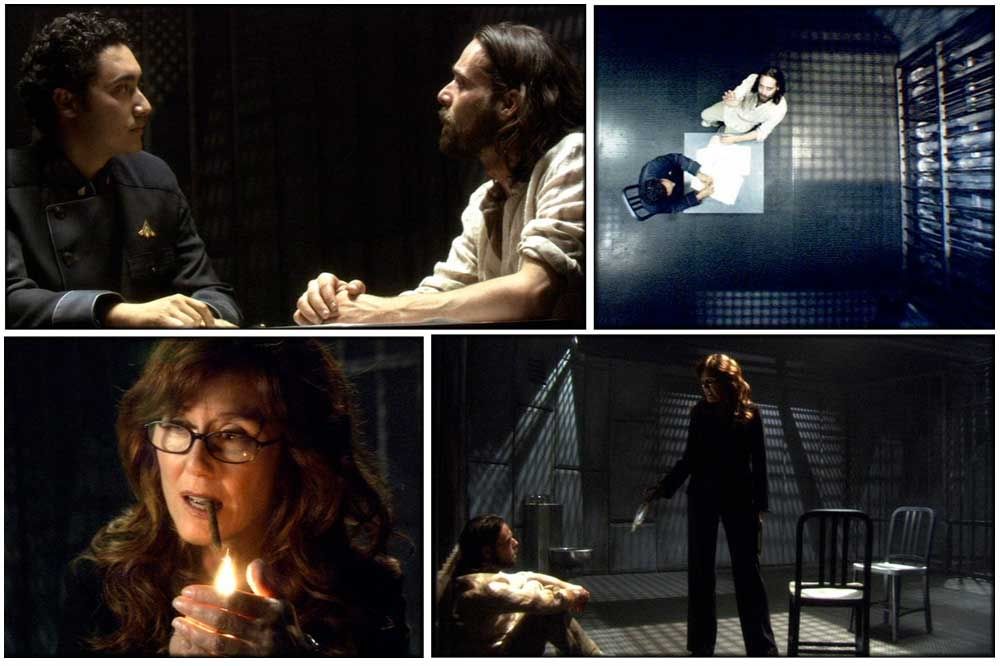
 IN THE PALE MOONLIGHT,
STAR TREK: DEEP SPACE NINE
LG: Michael Angeli described Ira Steven Behr as “a godfather to a bunch of us” and as a “connector.” How would you rate Ira’s effect on you and your work?
MT: I only got to work with Ira when I was freelancing for Deep Space Nine, but I think even then he defined for me what a show runner should be. I remember he came in one morning while we were working on a break for one of my episodes, and said he had almost driven off the road the previous night when he realized we had made a serious mistake with one of the characters. He figured all of us must have had the same reaction. In fact, none of us had, and certainly none of us had narrowly avoided rocketing off an on-ramp while pondering the difficulties of the break. What that told me is that Ira, like all great show runners, never stopped thinking about his show and sweating the problems. The problems of the characters seemed as real to him as his own.
LG: You also worked with Michael Piller on The Dead Zone series. The connections keep piling up, since Piller worked with Ron on ST: TNG, and DS9, as well as with Ira. So, what can you say about what it was like working with Piller and what was it like to know him?
MT: As I mentioned above, I consider Michael one of my mentors, but when I joined the Voyager staff, he was just a consultant on the show. It wasn’t till I joined the Dead Zone staff that I got to work with him directly. Like Ira, he was a consummate pro who was intensely engaged with the characters and stories he created, but who rewarded writers for thinking outside the box and avoiding anything that smacked of convention.
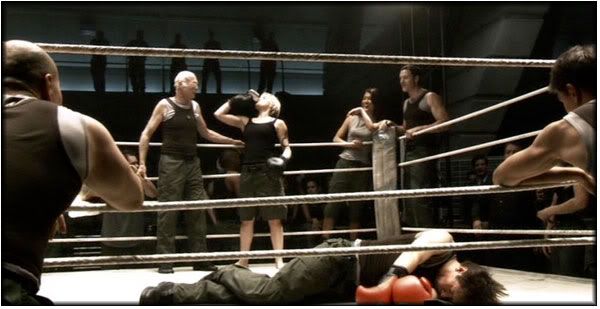
 The first rule of Galactica Fight Club is…
UNFINISHED BUSINESS
ProgGrrl: “Unfinished Business” (and even more so the extended cut included on the season three DVD set) really broadened the view of so many of the personal relationships between the show's characters. Other than establishing the reason for the drastic changes in the Lee and Kara dynamic that were first shown in the season two finale, what other major goals were on the plate when writing this episode?
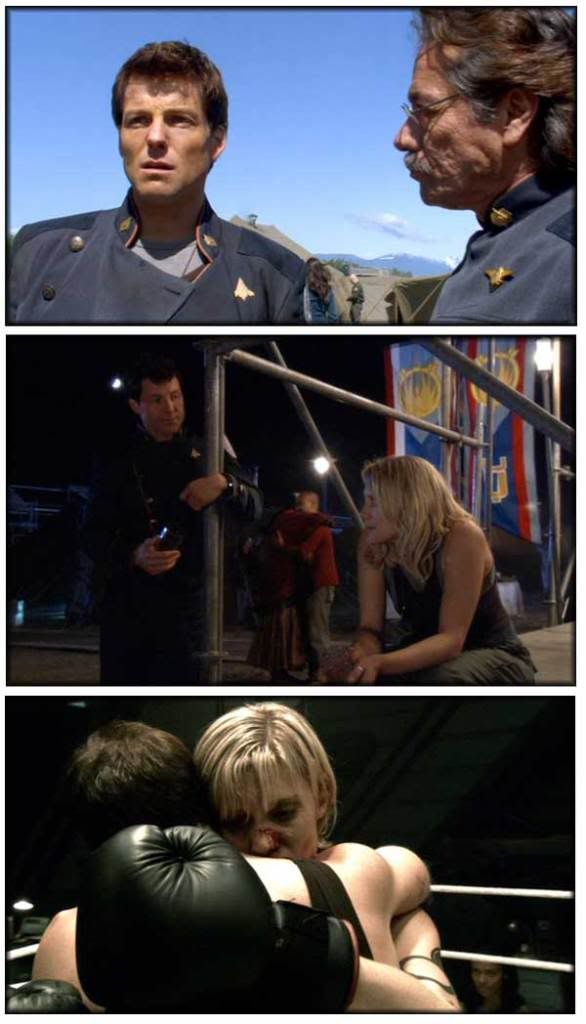
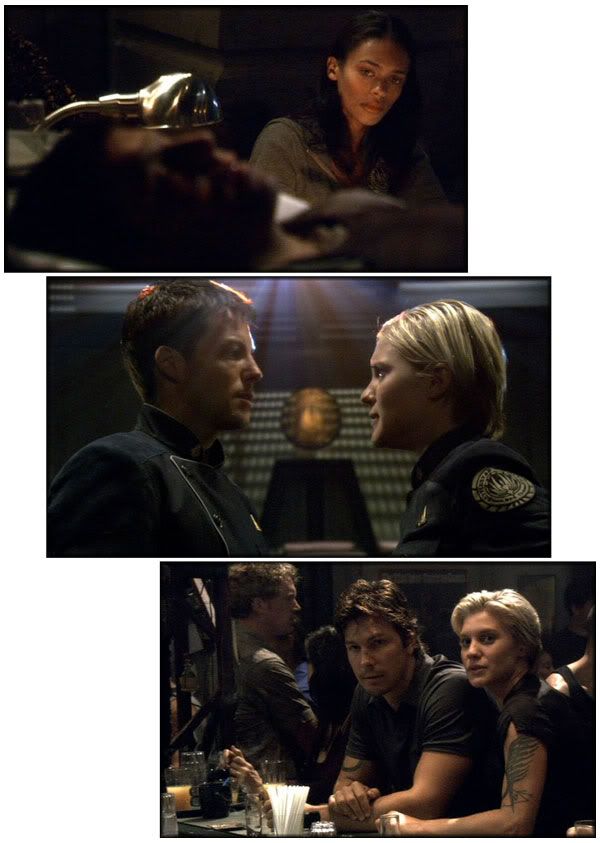
MT: Well, in a general sense, we just wanted to fill in some of the backstory of that missing year, and to do it through the lens of some single eventful day in the lives of our characters. When I first pitched the idea of doing a Fight Club-like episode, Ron thought it would be the perfect present-day bookend to pair with those beats from the past. But there were no real “goals” beyond that general intent, apart from putting the Kara-Lee relationship front and center and taking it to a new place. The story also evolved in a very organic and unconventional way, partly as a result of production and scheduling issues. Because the New Caprica exterior sets had to be struck before this episode—the eighth of the season—was slated for production, we ended up writing and shooting the entire past storyline first, then returning a couple of months later to shoot the present-day boxing sequences. Given that this was my first Battlestar episode, it was a bracing immersion in the unconventional BSG creative process that Ron Moore fostered (translation: Ron threw me in the deep end of the pool and laughed while I floundered), but ultimately very liberating.
 "I don’t care who frakkin’ knows!"
Baggage delivered in UNFINISHED BUSINESS
PG: In an interview you did around the time “Razor” aired you mentioned that the editor of “Unfinished Business,” Michael O’Halloran, was the one who campaigned for the longer cut to get on the DVD. What are your feelings about the broadcast cut versus the longer cut, now that both are available for all to see?
MT: As a writer, my personal tendency is to resist cutting anything in the subconscious hope that the network might be so overwhelmed by the quality of the piece that they would decide to cut the commercials instead. Never seems to happen. So the opportunity to see the entire script play out was very enticing. On the other hand, after watching—make that wallowing—in Mikey O’s luscious extended cut for a spell, I perversely found myself gaining a new appreciation for the concision and compressed energy of the original TV version. In other words, I think they’re both pretty cool.
 Adama and Tyrol work out some issues
in UNFINISHED BUSINESS
PG: What has been your reaction, if any, to the various and often heated fan responses to episodes like “Unfinished Business” and “Taking A Break From All Your Worries,” which spend most of their screen time delving deeply into the character’s private and emotional lives, instead of a more typical sci-fi plot?
MT: Hey, I like a good space battle as much as the next geek, but as I’ve gotten older I’ve found character drama more satisfying. That’s what drew me to Battlestar in the first place and it also colors my current TV watching habits, as I find myself gravitating to new shows like Mad Men that place a similar premium on character work. Which is not to say that I haven’t relished the opportunity to write shows that are heavy on both character and action (c.f., “Razor”). But one of the things that’s so cool about BSG is that sometimes you can plain forget that most of the action takes place in outer space. For example, I recall that Ron was very proud of the fact that “Unfinished Business” had so little sci-fi business—maybe just one shot of a Raptor flying overhead in an early New Caprica scene. But then the sci-fi trappings of BSG were never the point, which in an odd and perhaps counterintuitive way is why it was such a sci-fi milestone.
 "For all his crimes, he’s one of us."
TAKING A BREAK FROM ALL YOUR WORRIES
PG: “Taking A Break” brings front and center many of the most profound themes of the show (guilt/culpability/justice/redemption) and aims a magnifying glass at the Baltar and Apollo characters. It also presents a rather unusual tone…I think that comes from so much screen time given over to Baltar’s striking hallucinations. Many fans I talked to back then became fascinated with the meticulous intercutting between Lee’s apology speech to Dualla at the bar, and Baltar’s speech to Gaeta about culpability and forgiveness. What were the goals here, and how much of this came during shooting and cutting?
MT: As I recall, the decision to intercut the scenes was one that Eddie Olmos, who made in post, and which Ron then refined in his editing pass. Battlestar episodes tend to run long, and this one was no exception. But as the saying goes, necessity is the mother of invention, and in this case Eddie used intercutting both to condense the material and to find connections between scenes that weren’t necessarily envisioned by my script.
 "Kara Thrace and her special destiny?
Sounds like a bad cover band."
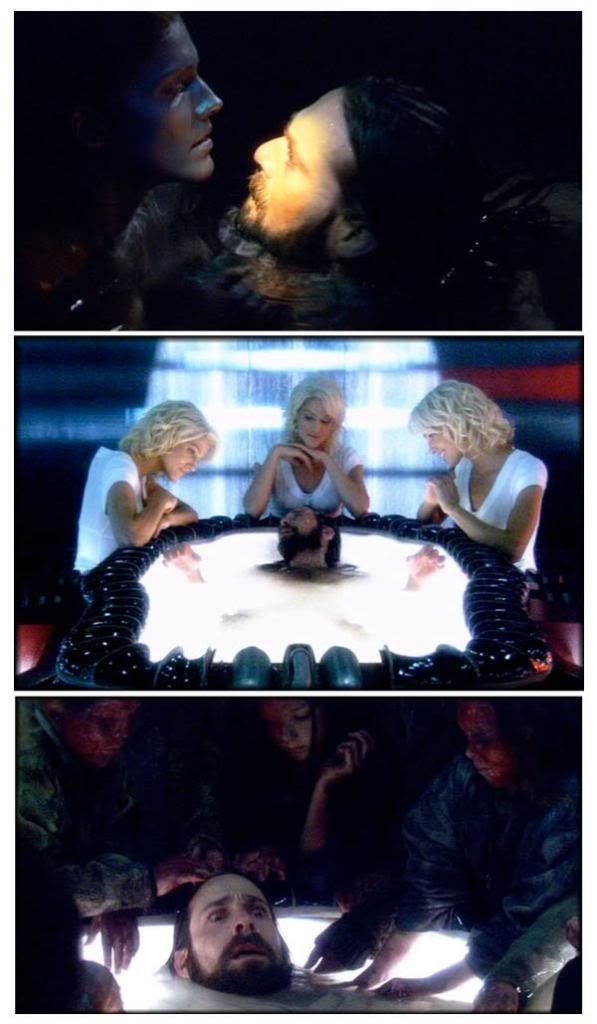
TAKING A BREAK FROM ALL YOUR WORRIES
LG: How did the episode evolve in discussions with Olmos, and how would you describe working with him on refining and crafting the impact of an episode?
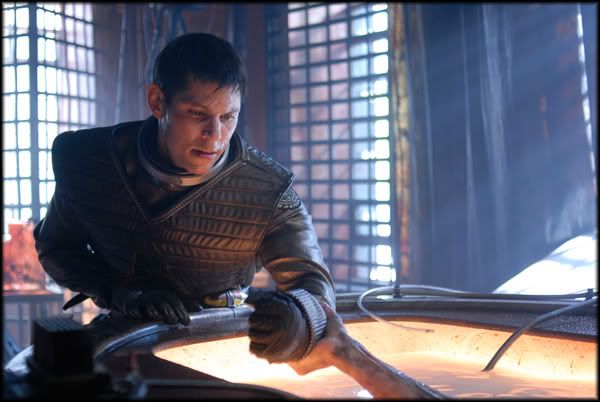
MT: In addition to being a brilliant actor, Eddie is also—as should be pretty obvious by now—a very talented director. His directing process also seems draw from the same well of instinct and intense emotionality that he taps as actor. The result is that he comes up with a lot of ideas and images that that can feel surprising, even startling at first, but ultimately prove very effective means of deepening the meaning of a scene or story. For example, in “Taking a Break,” he initially wanted to have a lot of “little people” crowd around Baltar in his vision tub and then drown him. At first, it seemed weird to me, like an outtake from The Wizard of Oz. But it was really the image that was compelling to Eddie, and as he continued to think about it, the “little people” became children, resulting in one of the most compelling visual sequences of the show, as these burned and bloodied little kids—presumably the youngest casualties of the Cylon attack on Caprica—carried Baltar down to a watery grave.
 "In his eyes, he’s the victim, not the criminal."
TAKING A BREAK FROM ALL YOUR WORRIES
LG: Eddie also worked with Bear McCreary on selecting songs for the background in Joe’s bar -- did you work with them on the song selections?
MT: Nope. That was all Eddie and Bear. The multi-talented EJO is also a musician and songwriter. In fact, he also created the melody for the little lullaby that Baltar and Number Six sang at the top of the episode.
PG: Do you find any major difference between writing for a serialized drama versus writing for a show that creates more stand-alone stories? Does it ever raise questions knowing how much work the viewers may need to do to catch up?
MT: There is a difference, and Battlestar is definitely the most serialized drama I’ve worked on. But then many of the most compelling dramas of recent years have been equally serialized, whether it’s The Sopranos, Lost or The Wire, etc., so I’d guess that a lot of viewers have gotten used to this. In the case of BSG, I’ve met plenty of fans who watched the show from the beginning, and a roughly equal number who picked it up a season or two in and caught up by watching the DVDs. And call me a “Method” writer, but while there have been plenty of good TV “dramas” that weren’t very serialized (Law and Order, CSI, and a lot of the procedural shows, for example), for my money the real drama comes from character and the evolution of character, and that requires a serialized approach.
LG: I asked Angeli about how “Guess What’s Coming to Dinner,” and “Sine Qua Non” are so closely linked, if you two shared drafts and such to make it all fit so seamlessly, and he said, “As for endings and beginnings, Taylor and I follow each other often and we always hash it out together.” How would you describe that process, and since “The Hub” follows on the heels of “Sine Qua Non,” did you have similar discussions with Jane Espenson?
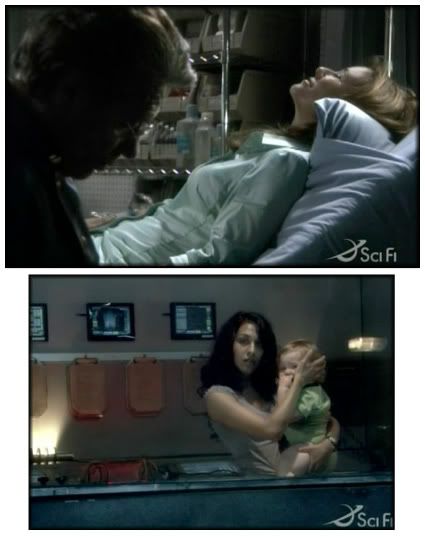
MT: Whether by intelligent design or mere chance, Michael and I have indeed tended to follow one other. So naturally we talk and swap drafts, and so does the staff as a whole. With “Sine Qua Non,” I decided to pick up from the moment Mike’s show left off by playing out the death of Natalie, the ill-fated Cylon leader. There’s even a more subtle connection or “tribute” here, since I had her mutter the words of the Cylon death prayer (or “Cylon Kaddish,” as Mike likes to call it) that Mike invented in his first Season Three episode, “A Measure of Salvation.”
With “The Hub” and “Sine Qua Non,” Jane and I were telling a pair of stories that were happening at the same time but in different settings and involved different sets of characters. So they weren’t “serialized” in the sense that we typically understand the word. But Jane and I still consulted because there were overlapping story elements, like the Raptor that makes it back to Galactica with a dead pilot aboard. And of course, there are parallel themes at work as both Adama and Laura, through different means circumstances, come to realize how much they love and need each other.
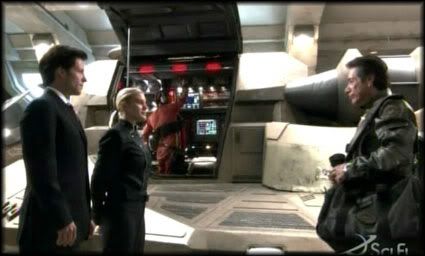
 “I can’t live without her.” Adama sets off
to find Roslin in SINE QUA NON
LG: A number of your episodes have been directed by Edward James Olmos. What does working with him bring out in the process?
MT: As I said above, Eddie’s connection to the material—and to the series as a whole—is profoundly emotional. As a result, in my experience he’s less interested in critiquing story elements than in finding means—through aspects of staging or visuals—to bring out deeper layers of meaning from the scripts—layers that sometimes weren’t apparent to the writers. And with Episode 420 (“Islanded In A Stream Of Stars”), all I can tell you is that given Eddie’s deep bond with the series, he takes the show’s theme of “endings” very seriously, and even to a disturbing extreme. But you’ll see.
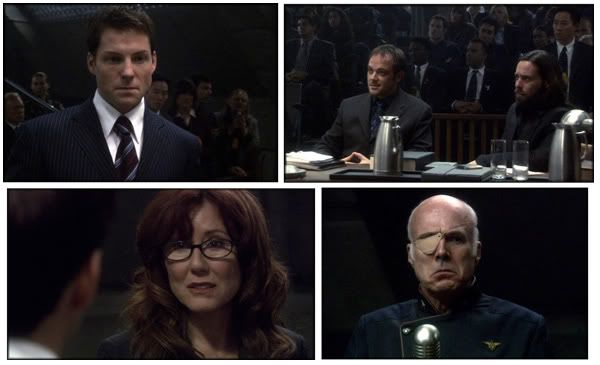
LG: “The Son Also Rises” introduced Romo Lampkin, and you picked up Romo’s story with the trial in “Crossroads Part 1.” What were some of the challenges in working on that script, since you were basically given the middle piece of a three parter?
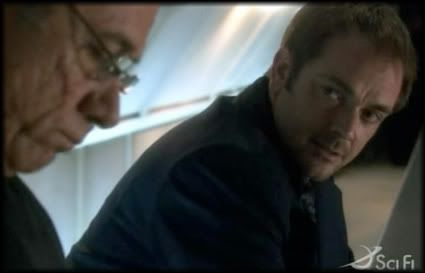
MT: The main challenge was trying to maintain the ridiculously high bar that Michael Angeli set when he created the remarkable character of Romo Lampkin, and to give the equally remarkable Mark Shepherd enough scenery to chew. That being said, once I got in the swing of it, it was a lot of fun. As a writer—by definition someone who cares about words—it’s great fun to write a character whose verbal dexterity and intelligence is always threatening to outstrip your own.

The Trial. CROSSROADS PART 1
PG: In “Razor” you drop the bomb that Kara Thrace and Her Special Destiny might not be so good for humanity. When did the ‘harbinger’ idea get introduced into the writers room -- during the creation of season three, or while breaking “Razor”?
MT: The network wanted a sense that “Razor” was in some way setting the table for the fourth season. We talked it over with Ron, and it ended up boiling down to a few lines of dialogue that I wrote into the ending of the show. We’ve since had to recall the “harbinger” prophecy so many times that I may refrain from ever using the word again. Around the writers’ room, Kara was simply referred to as the “hamburger of death.”
LG: Supposedly Universal Home Video wanted the extended Hybrid Prophesy on the longer DVD cut of “Razor” to kind of promote BSG Season 4. What was the challenge in coming up with that kind of foreshadowing prose poem, that sets up events from the occupation of New Caprica, all the way to the Cylon Civil War and the revelation of the final five?
MT: It was intensely challenging. And fortunately I didn’t have to do it. Since I was already writing another script, the task fell to the estimable Mark Verheiden, who probably knocked it off in all of few minutes or so.
PG: The “Razor” telefilm is labeled as episodes 1 & 2 of Season 4.0. When breaking and writing it, did you feel like you were working on a feature, or on the TV show? Was there any difference for you?
MT: I always thought of it as a movie, if only because that was way cooler. As in, “Hey, I’m writing a frakkin’ movie!” And while the network may’ve required us to break the script into two halves, I’ve never seen actually “Razor” air as anything but a movie. So I’m not sure who, if anyone, has been forced to watch it in two parts. To quote Mr. T, I pity the fools.
PG: On the “Razor” DVD commentary by you and Ron Moore, there is a discussion about the characters on the show who have become female in the reimagined series (Starbuck, Cain, Boomer). You mention that whereas in the 1970s Battlestar, these characters would stalk around flourishing canes, switches or cigars as masculine symbols, now they are “women with real balls.” Many of the female BSG fans I know are completely entranced by all the ballsy women on this show. Do you and the rest of the writers feel you are doing anything new and different for women in science fiction? What do you think about some calling the show a possible “feminist classic”?
MT: I’ve got absolutely no problem with calling Battlestar a “feminist classic,” or for that matter the greatest work of cinematic art ever committed to film, or even the cornerstone of a healthy diet. But the truth is that Ron set the mold with the miniseries, by creating indelible characters like Laura Roslin and Starbuck, and all the rest of us had to do was to fall in love with them and try to sustain them, like a healthy romantic fantasy, for the duration of the series. And personally I do like my women on the ballsy side, if not to the degree that Eddie Murphy might (not that there’s anything wrong with that). I miss Starbuck already.
LG: Were you involved in the casting selection of Nico Cortez? He was perfect as Young Adama.
MT: I was not involved in the casting, but I agree: he was perfect. So perfect that Mojo (Adam "Mojo" Lebowitz), one of our VFX guys, has been relentlessly campaigning for a “Young Adama” series.
LG: Fans of the original BSG (like me) loved seeing the old school Cylons in action. Since the VFX guys pulled it off so well, do you hope to see stuff from the first war again, possibly in future telefilms?
MT: The Old Cylons will rise again. ‘Nuff said.
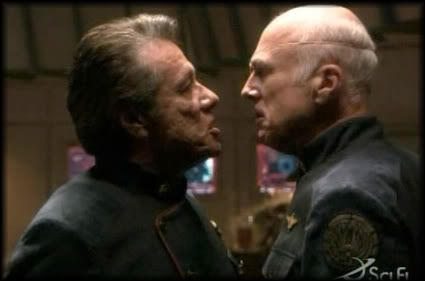
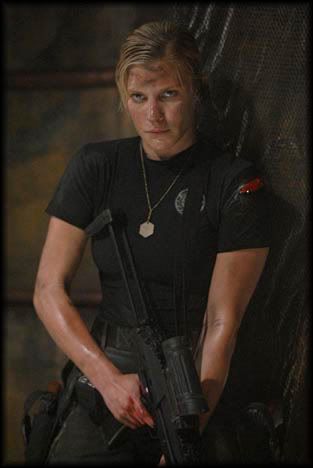
 "She’s the President – not some
frakkin’ skin job I’ve been banging!"
Adama and Tigh come to blows in SINE QUA NON
LG: One of our readers, Ellen Chapman asks: In “Sine Qua Non,” there is a huge number of shocking revelations even for a BSG episode - Caprica's pregnancy, Adama and Tigh's fight, Romo's mental illness, Adama's resignation. Was there much discussion in the writer's room about what you would have to do to avoid the episode becoming soap-like?
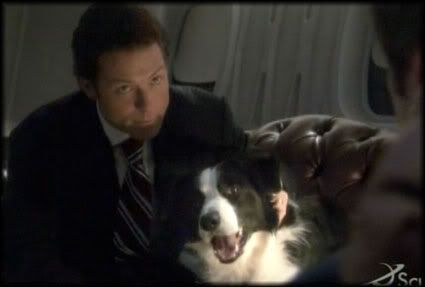
MT: No, and it hindsight we should’ve worried about that. But the episode seemed to work well on the page. It was only after it was shot that it became apparent just how much story we were trying to jam into 42 minutes. This is one episode that would be well served by an extended cut, but that’s the way it goes sometimes: if you consistently try to tell ambitious stories, occasionally you bite off a bit more than you can chew. I still dig the episode, though. I just wish all those jostling storylines had more room to breathe, and that Jake the Dog, in particular, had more airtime (more on that later).
LG: It seems by this point in the series, everyone’s emotions are raw. They’ve been stuck in space for all these years clinging to hope of finding earth... They seem emotionally spent and on the edge of sanity by this point. Many are in the throes of uncontrollable, powerful visions. I heard a writer once describe the process as chasing the characters into a tree, and then hurling rocks at them. Did you and the rest of the BSG writers enjoy tossing rocks at the characters and seeing how they react?
MT: Throwing rocks at treed characters strikes me as a somewhat sadistic metaphor. Or is it simile? I prefer to think that if we appear to torment our characters it’s because the way they deal with obstacles and setbacks—which is not always heroically—makes them seem that much more human. So call it “tough love” and I’m with you.

Adama reads to Roslin, and Tory does the deed, in THE TIES THAT BIND
PG: All of us Battlestar Galactica (and Friday Night Lights) fans are waiting patiently for any news about the pilot for Virtuality, written by yourself and Ron Moore and directed by Peter Berg. Were you involved in the shoot this summer? Any news on when we might hear about the show’s fate?
MT: I was involved in the shoot this summer, spending some six weeks in Vancouver with our talented cast and director. We’re editing the show now and have our fingers crossed that The Powers That Be will dig it as much as we do and promptly green-light it to series.
PG: Showrunners, writers and TV producers have a lot of different opinions about interacting with fans in the online space. How do you view the online relationship between the creative team and a show’s fans?
MT: I don’t troll the webs that much, but when I do I often find some really thoughtful critiques—be they raves or pans. You can’t help but respond to that kind of material, and that’s probably how fans’ viewpoints affect me. The flipside of that coin, however, is that I don’t care much about more superficial assessments—fan polls, ratings, etc.—because ultimately I’m not trying to write for some group of strangers. The simple truth is, you can’t. You can only write for yourself and the handful of people you work with and hope that you audience responds to the same things you do.
 RAZOR’s ballsy hamburger of death
LG: As the series wraps up, what’s been the best thing about working on BSG, and what will you miss the most?
MT: The best thing was getting the chance to write without worrying about the conventions and boundaries of mainstream television, while working with such a great group of writers. Okay, maybe that’s two things. And to say “frak” a lot. So that’s three things. What I’ll miss most is the chance to work with a remarkable group of writers. Oh, and Starbuck. I’ll really miss Starbuck.
------------------------------------------
We have some questions for you from Sitrep readers (and to our readers, please note some have been edited for brevity).
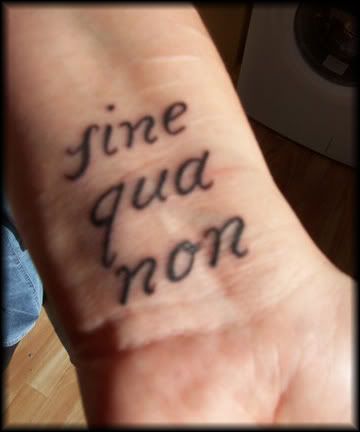
 One of the Season 4.0 episodes inspired a fan. Permanently.
[Courtesy Battlestar blog]
Peter asks: It seems to me and the fans I talk to, that your episodes are among the most emotionally challenging of the series. How is it decided which episode goes to which writer in this show -- particularly this year, when the whole season is one long story arc?
MT: Pete—can I call you Pete?—often the assignments are dictated just by who’s up next in the rotation. But since we’re each intimately involved in the crafting of the episodes that we’re assigned to, every story ends up being very much a reflection of the individual writer. So if my eps strike some as being among the most emotionally challenging, I guess that’s because I’m clearly the most emotionally challenged writer on staff. Wait, does that make sense? Maybe not but there may still be some truth in it. I’ll have to run it by my therapist.
Joseph asks: how likely is it that we might see more of Young Adama now that there are three BSG movies in the works? I thought Cortez was fantastic and myself would like to see more of the First Cylon War.
MT: So say we all. However, as of this moment, there’s only one movie in the works and it doesn’t feature Young Adama. So, um, you may be shit out of luck. In which case relish his brief shining moment in the sun and buy the action figure, which is also pretty cool.
 Nico Cortez as “Husker” in RAZOR
Radii asks: Will the reason for the late emerging self-awareness of the Final Five, especially the fifth, happening so late in the story be explained? Why would the most important Cylon be the last to know?
MT: All will be explained, Grasshopper.
Wouter asks: In an interview last year you said that Boomer would be back “big time” in season 4. We have seen glimpses of her in a few episodes so far…can you confirm that there is more to come? Is this to happen in these remaining “front ten” eps, or later in the season?
MT: There is indeed more Boomer to come when BSG returns next January. She plays a significant role in the final run of episodes.
Karie asks: We haven’t gotten to see Lee and Kara spend much time together so far this year. Is there a specific reason this relationship is being ignored for the time being? Or has it been pushed aside for other things and we should not read anything into the huge gap?
MT: I think as a group we felt that we had taken that relationship as far as it could go for the time being. But rest assured, it will not be entirely resolved until the end of the series.
Ashoka asks: In “Sine Qua Non” are you and the other writers concerned about how colonial democracy is now being presented, with Admiral Adama essentially having veto power to prevent Tom Zarek from becoming president? Shouldn’t the population object to what amounts to a de facto military coup?
MT: No doubt, but I think it’s plain by now that the Fleet is anything but a model democracy. More charitably, it’s the closest thing to a democracy that our hunted and huddled masses can manage given their precarious circumstances and the very real need to balance freedom and security. Which may sound like a neo-conservative viewpoint, but I think if we ever get down to 30,000 people, we might be more forgiving of a benign autocracy.
 "A genuine hero of the Resistance" - Jake’s back!
SINE QUA NON
John asks: Could you tell us the story of how the return of Jake the Dog made its way into this last episode?
MT: It was Ron Moore’s idea to give Romo a new pet to replace his dead cat, and to make that new pet Jake. Jake had an even more prominent role in the script, but what was arguably his “big scene” was left on the cutting room the floor. The scene called for Romo to look deeply into Jake’s eyes, as if he might find some answers there to his doleful existential questions. It sounds goofy, but in a show that turned on an invisible dead cat, it was the kind of scene that helped pull together the many strands and dilemmas of the story, boiling them down to a silent but evocative moment between a confused man and a puzzled beast. In the end though, we thought it distracted from Adama’s final moment waiting in the Raptor for Laura. People before dogs, I suppose.
Mike asks: Should we read anything into the fact that the title of your episode "Sine Qua Non" is a Latin phrase translated into English during the course of the show? I.E., is it a hint that BSG is set in our far future?
MT: These are the kind of questions I hesitate to answer. Instead I would say it sounds like an interesting theory, so keep watching to see if you’re right.
 "Everyone has his limits." Adama and Lampkin
discuss the meaning of SINE QUA NON
Ann asks: About the poem that Starbuck had written on her apartment wall on Caprica, the one next to the infamous mandala painting: it tells of 'watching a boy turn into a man'. Have the writers discussed if this poem has any import to the story as the painting did or was it just a random writing?
MT: According to David Weddle and Bradley Thompson, who wrote the mandala episode, the art department came up with the poem. So it’s a mystery even to us.
 "Do I seem different to you somehow?"
THE TIES THAT BIND
Jeanne asks: I have a question about where Starbuck is at this moment of season four. She gets back after that really intense experience on the Demetrius and now appears to be a well-behaved CAG. She does not seem concerned about the hybrid message, Helo’s attempted mutiny, the Cylon ship she brought back just kidnapped the President, this Earth thing or what happened to her during her two missing months. And it seems that she is no longer under suspicion of being a Cylon and is back to her leadership position in the fleet. I was wondering to what extent these omissions were deliberate, to what extent you were making assumptions here, and to what extent things had to be cut for time or lack of primacy.
MT: As regards Kara’s present situation and her seeming attitude toward it, I would say this: denial is a powerful psychological drive.
Zoe asks: I really enjoyed the Sixth Sense-like game you played with Romo's cat - seeing it around the room when it was really dead, Lee tripping on the empty food dish. Was Romo really pushed over the edge by the cat's death, or was this another one of his calculated emotional manipulations to get Lee to go for the presidency?
MT: I don’t think Romo is quite that calculating, and hence I believe he truly was pushed over the edge by Lance’s death. At the same time, there was doubtless a part of him that wanted confront Lee with his own blind ambition and see if Lee could rise to the occasion, as he did, by forcefully making the case for hope that Romo was afraid to make for himself.
Alanna asks: Why did you guys reveal Lee Adama’s full name as Leland Joseph Adama? How do you choose which new aspects of a character's backstory to introduce in an episode? Have you invented character histories that haven't yet been shown for others on the show?
MT: The characters all have backstories that Ron created and the writers are privy to, but in this case I just up and invented Lee’s full name, thinking perhaps to highlight yet again his connection with his grandfather. And since no one else objected, it stayed.
Grant had several questions for you, and we decided to indulge him…firstly he asks: Who is probably your favorite character on BSG in terms of most enjoyable to write? And which character/relationship arc do you find most appealing?
MT: Gosh, I really do love writing them all. But I guess I would say Tigh is a definite favorite, given that he can be so heartbreaking and also so profanely funny. And from “Unfinished Business” you might rightly intuit that the Starbuck-Lee relationship is the one that probably has the strongest hold on me. The idea of the star-crossed lovers who may or may not be meant to be together hits a lot of personal buttons for me (which in turn may explain why I’m still single). On the other hand, I also dig the relationship between Adama and Tigh, which is equally volatile and yet somehow more grounded. These guys literally beat the crap out of each other and yet they hang onto their friendship. I guess that gives me a lot of hope about the way some relationships can survive no matter how much shit life heaps on them.
Grant asks: What other television shows do you currently watch and love? When you watch those shows, do you sort of subconsciously compare them to BSG and think about what you would've done differently, or are you able to turn "writer mode" off and just enjoy the shows on their own?
MT: I’m currently into Mad Men, Entourage, Californication and True Blood—which means my TIVO does its heaviest lifting on Sunday nights. And naturally if you’re the type of writer who’s never really satisfied with their own work, you can’t help but take lessons from other stuff you think is really good. But generally I don’t compare other shows to BSG, I just enjoy them like any other fan.
A couple of years ago, Time Magazine declared BSG the best show on TV. This year, Mad Men seems to be the series that is getting the most critical attention, and deservedly so—because it’s fresh, brilliant and very cool.
Which isn’t to say that I don’t think Battlestar still isn’t one of the best shows on TV. And come January, I think we’re going to prove it again.